
Amulets of the Most Venerable Luang Phor Uttama from Wat Wang Wiwekaram.

📿 The Most Venerable Luang Phor Uttama ဦးဥတ္တမ,
the great Mon master of Sangkhlaburi
The Most Venerable Luang Phor Uttama (LP Uthama), also known as Luangpho Ajahn Tala Uttama or Phra Raj Udom Mongkhon, was one of the most revered Buddhist monks in the Sangkhlaburi region, in the province of Kanchanaburi, on the border between Thailand and Myanmar.
Born in March 1910 in Mawkanin, present-day Myanmar, under the name A Maung, he belonged to the Mon people, an ancient Buddhist community deeply rooted in the Theravada tradition. His monastic name was Uttamarambho. After political unrest and civil war in Burma, he left his native country and found refuge in Thailand, where he gradually became a major spiritual figure for the Mon, Karen, Burmese, and Thai populations.
The Most Venerable Luang Phor Uttama was a great connoisseur of the Burmese Nath spirits tradition and possessed profound esoteric knowledge. He was also a renowned alchemist and healer.
He is also credited with being one of the last Venerables to craft "mala of the 108 temples" according to tradition: undertaking a long pilgrimage to 108 temples, collecting earth and Buddha tree leaves from each temple, then burning the leaves, mixing them with the earth, making beads (with a takrut inside bearing an incantation) and coating them with lacquer, thus creating very sacred rosaries that are still highly sought after by Dharma practitioners.
Founder of Wat Wang Wiwekaram
Luang Phor Uttama is best known as the founder of Wat Wang Wiwekaram, also called Wat Parungsee, located in Nong Lu, Sangkhlaburi, Kanchanaburi. The temple was built with the help of Mon and Karen communities who had taken refuge in this mountainous region near the Thai border.
This temple quickly became an essential religious, social, and cultural center. Luang Phor Uttama not only taught the Dharma there: he also offered moral and material refuge to displaced populations, especially Mon refugees from Myanmar. His life thus illustrates the ideal of the compassionate monk, simultaneously a meditation master, community builder, and protector of the most vulnerable.
A master of meditation and compassion
Renowned for his deep Vipassana meditation practice and his austerity, Luang Phor Uttama was admired for his discipline, wisdom, and benevolence. Devotees considered him a true spiritual father, capable of uniting people of different languages and origins around the Buddhist faith.
His influence extended far beyond Sangkhlaburi. He was respected throughout Thailand, but also in Myanmar, where he received a significant honorary religious title in 1997. His relationship with the Thai royal family further strengthened his spiritual prestige, particularly during ceremonies related to the large Bodh Gaya-style pagoda built at Wat Wang Wiwekaram.
The Bodh Gaya pagoda and the Mon bridge
Among the most famous achievements associated with Luang Phor Uttama is the great pagoda inspired by the Mahabodhi temple in Bodh Gaya, India, a sacred site of the Buddha's Enlightenment. This pagoda, about 50 meters high, has become one of Sangkhlaburi's spiritual symbols.
He is also linked to the construction of the famous Uttamanusorn bridge, often called the Mon bridge, one of Thailand's longest wooden bridges. This bridge symbolically connects local communities and remains an emblematic site in the region today.
Death and spiritual legacy
Luang Phor Uttama passed away on October 18, 2006, at Siriraj Hospital in Bangkok. His body is preserved at Wat Wang Wiwekaram, where devotees still pay homage today.
His legacy remains alive in Sangkhlaburi. Wat Wang Wiwekaram, the submerged ancient temple that has become a tourist site, the Bodh Gaya pagoda, and the Mon bridge all bear witness to his work. More than just a famous monk, Luang Phor Uttama remains in the memory of devotees as a master of compassion, a protector of refugees, and a living bridge between Thailand, Myanmar, and the Mon people.
Luang Phor Uttama thus embodies a rare form of Buddhist sainthood: that of a master capable of transforming exile, poverty, and human divisions into a lasting work of faith, peace, and fraternity. His amulets, statuettes, and rosaries from the 108 temples are still highly sought after by collectors today.
8 products
-
Rare Ancient Alchemic Buddha Statue - Most Venerable Luang Phor Uttama Out of stock

-
Phra Phuttha Chinnarat Amulet (1993 edition) - Wat Phra Sri Rattana Mahathat Out of stock

-
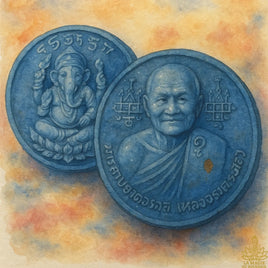
Blue amulet Phra Pikanet (Ganesh) – Luang Phor Uthamma – Wat Parungsee (1995) 47.70 €
-
Ancient Sacred Lot Blessed by Luang Phor Uthama – Statue of Phra Upakut, Rosary of 108 Temples and Pa Yant of Mae Nang Kwak Out of stock

-
Sacred bronze statue of Phra Upakut (Wat Parungsee) + Phra Phong Kradum Thong amulet 185.50 €

-
Roop Lor Medal of the Most Venerable LP Uthama. 42.40 €

-
Amulet of Phra Pidta Buddha - Most Venerable LP Uthama. 71.55 €

-
Precious Buddhist rosaries from the 108 temples of the Most Venerable LP Uthama. from 106.00 €


