
Thai amulets of the Most Venerable LP Muang.

🙏🏽 Biography of the Most Venerable Luang Phor Muang Nakseno of Wat Yang Ngam 🙏🏽
The Most Venerable Luang Phor Muang Nakseno Nakseno
(Phrakru Sunthorn Jariyawat), a respected monk from Wat Yang Ngam, in Ratchaburi province, Thailand, is one of those great Thai Buddhist masters whose reputation rests as much on the depth of Dharma as on compassion for the faithful.
He was born on August 21, 1912, in the village of Ban Moo in Ratchaburi province. At the age of 19, he received monastic ordination at Wat Pak Tor on June 8, 1931. His preceptor was the Venerable Luang Phor Prok of Wat Chom Lom.
From his first years of monastic life, Luang Phor Muang showed a deep interest in the study of Dharma. In just two years, he obtained his first Buddhist teaching diploma at Wat Pak Tor, then continued his studies with determination. In 1935, he obtained a higher level of Buddhist teaching, and then became a teacher himself in 1937, transmitting both the teachings of the Buddha and certain traditional knowledge related to the esoteric sciences of Wicha.
His spiritual commitment and rigor were quickly recognized. In 1945, he became the monk responsible at the sub-district level. Then, in 1958, he was appointed Abbot of Wat Yang Ngam and monastic head of the district. From that period, his role extended far beyond religious functions: he actively participated in the development of the temple and the support of the local population.
Luang Phor Muang contributed to many public utility projects: construction of monastic quarters, construction of the main hall of Wat Yang Ngam, fundraising for children, support for novices, distribution of Dharma books, and construction of a bridge to facilitate the lives of the inhabitants. For him, Buddhist practice should not remain theoretical: it should manifest concretely through generosity, mutual aid, and benevolence.
Wishing to make Dharma accessible to as many people as possible, he also founded a Buddhist teaching school open to the public. He hoped to train a new generation capable of sincerely understanding the Buddha's teachings and applying them in daily life.
Testimonies describe him as a very gentle monk, never getting angry and not harshly reprimanding the faithful. His teaching method was based on patience, compassion, and personal example. Villagers, officials, merchants, and local leaders deeply respected him, and many came to support the temple's projects when he requested help.
📿 Disciple of Luang Pu Jai of Wat Sadej 📿
Luang Phor Muang was also a disciple of the very famous Luang Pu Jai of Wat Sadej, a master renowned for his takrut and sacred knowledge. He is said to have studied with Luang Pu Jai even before Luang Phor Yod of Wat Kaew Charoen. After Luang Pu Jai's death, Luang Phor Yod often came to consult Luang Phor Muang to receive his advice.
This spiritual lineage explains the importance of takrut in Luang Phor Muang's tradition, particularly takrut related to protection, Metta Maha Niyom, and Kong Krapan invulnerability. His amulets were particularly sought after by the faithful who reported experiences of protection, improvement of relational luck, and preservation during serious accidents.
✨ The amulets and takrut of Luang Phor Muang ✨
Luang Phor Muang only began consecrating his first medals with his effigy and his famous seven-colored thread takrut in 1985. These takrut were linked to the secret rites transmitted by Luang Pu Jai. Quickly, their reputation spread throughout Thailand.
Many faithful came to Wat Yang Ngam to request his amulets, takrut, and blessings. Among the talismans associated with his tradition, notable ones include the takrut Lookatat, Ko Kin Nom Ser, Mongkon Goa Yang, and other protective forms. Despite this high demand, Luang Phor Muang refused to work in haste and even in his old age, made his amulets one by one by hand. True to Luang Pu Jai's teaching, he insisted on preparing each ritual object slowly, with concentration and respect.
He also consecrated takrut inspired by the famous Takrut Naresuan Prab Hongsa of Luang Pu Jai. Some measured up to 25 centimeters and were covered with sacred powder Phong Putthakhun, then dried, lacquered, and adorned with gold leaf. In some cases, they also incorporated his hair and fragments of his monastic robe.
As he aged, his hands trembled more and more, and some disciples helped him draw the yant on the sacred powders, while respecting his ritual intention and blessing. Apart from takrut, Luang Phor Muang also distributed sacred beads Look Aum and ritual photographs with yant on the back. He was also invited to numerous Puttha Pisek ceremonies, where monks collectively consecrate amulets and sacred objects.
☸ Monastic Recognition ☸
Throughout his long religious life, Luang Phor Muang received several important distinctions. In 1958, he was granted the rank of Phra Kru Soothorn Chariyawat. In 1965, he became Phra Upacha, meaning a preceptor authorized to ordain new monks. In 1978, he was appointed head of education, and then in 1997, he became chairman of the district monastic committee.
These responsibilities show Luang Phor Muang's importance in local religious life. He was not only a master blessing amulets, but also an educator, a builder, a spiritual guide, and a pillar of the Buddhist community in Ratchaburi.
🪔 End of Life and Spiritual Legacy 🪔
Luang Phor Muang passed away on August 22, 2009, at Ratchaburi Hospital, due to complications related to lymph nodes in the stomach. He was 98 years old and had spent 78 years in monastic life (Pansa).
I was very fortunate to be able to visit the Most Venerable Luang Phor Muang in 2007 and 2008. He was a very humble, patient Venerable who treated his disciples like family.
After his passing, his memory remained very much alive among the faithful. Many still remember the phrase he often repeated:
“May everyone be healed.” Kor Hai Tuk Khun Jong Rak Sa
It perfectly summarizes the spirit of Luang Phor Muang: a master focused on inner healing, compassion, the practice of goodness, and the transmission of Dharma. His legacy endures through his teachings, his work for the temple, his consecrated amulets, and the grateful memory of those who revered him.
📜 See the photos I took during my visits to Wat Yang Ngam.
8 products
-
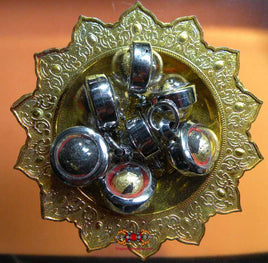
Sacred marble Look Aum Phratat of the Most Venerable LP Muang. 47.70 €
-
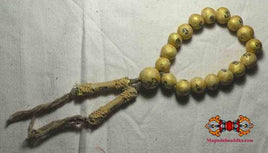
Votive Buddhist Rosary Look Phrakam Phratat of the Most Venerable LP Muang. 105.95 €
-
Roop Lor portrait medal of the Most Venerable LP Muang. 26.49 €

-
Roop Lor portrait amulet of the Most Venerable LP Muang. 52.99 €

-
Protective Thai amulet Phra Pidta of the Most Venerable LP Muang. 71.55 €

-
Krapaow Ngern Magic Bag of Fortune - Most Venerable LP Muang. 52.47 €

-
Roop Lor portrait amulet of the Most Venerable LP Muang. 63.59 €

-
Roop Lor portrait amulet of the Most Venerable LP Muang. 63.59 €


